


Hiring a CMMC consultant without mapping your data can lead to costly delays and inefficiencies. Discover how groundwork shapes compliance success.

November 25, 2026
Hiring a CMMC consultant before you’ve mapped your controlled information often leads to duplicated work and higher costs. The real efficiency comes from defining your data landscape first, then bringing in expert help.
A CUI mapping gap rarely stays contained to one department. A consultant hired without that map starts interviewing staff, guessing at system boundaries, and documenting assumptions that may not hold once the real scope surfaces weeks later.
A consultant's expertise is valuable, but expertise can't substitute for groundwork that was never done. When the scope of your controlled information isn't clear, much of that early work becomes guesswork, and guesswork gets discarded once the true picture emerges, taking the time and money spent on it along with it.
That's why a clear picture of where your information lives has to come before anything else in CMMC compliance. Skip it, and even the strongest consulting services end up circling back once the real scope is uncovered.

Before engaging a CMMC consultant, you need to know exactly where your controlled unclassified information (CUI) and federal contract information (FCI) are stored, processed, and transmitted. This isn't a formality to check off; it shapes every part of what follows in your compliance journey.
Skip this mapping, and your consultant has little choice but to build recommendations on assumptions. Once the true locations of CUI and FCI come to light, those early efforts usually need to be redone, which means paying for the same work twice.
That risk is especially real in Connecticut, where many businesses handle Department of Defense contracts inside IT environments complex enough to hide data flows, shared drives, or third-party systems touching sensitive information without anyone noticing.
Mapping your information first sets clear boundaries around what compliance actually requires. With those boundaries in place, every hour of CMMC consulting lands on something that matters.
It's tempting to assume that bringing in a consultant right away speeds up the path to CMMC certification. In practice, starting too soon tends to slow things down instead.
When the scope of your CUI and FCI is unclear, consultants end up spending extra time asking basic questions, reviewing systems, and revisiting decisions they thought were already settled. Assessments get duplicated, and interviews get repeated.
Consulting fees can quickly add up once an engagement is forced to backtrack this way. You pay for the initial round of work, and then you pay again when the real scope finally comes into focus.
That cycle wears on both your team and your consultant, and it does more than cost money - it delays progress toward compliance, putting contracts and business opportunities at risk in the meantime.
A CMMC consultant brings expertise in compliance management, cybersecurity standards, and the certification process, but that expertise only goes as far as the information handed over at the start.
To deliver real value, your consultant needs:
Without these details, consultants spend their time uncovering basic facts instead of remediating compliance gaps or preparing you for certification audits - and that's not the best use of a consulting budget.
Once controlled information has been mapped, the value of CMMC consulting services increases dramatically. The groundwork changes the engagement in several concrete ways:
Consultants can focus immediately on the systems and processes that matter, rather than searching for missing pieces.
With a clear scope, recommendations address real compliance gaps instead of hypothetical risks.
Policies, procedures, and system security plans (SSPs) can be tailored to your actual environment, not generic templates.
You'll know exactly which areas need attention before a third-party assessment, reducing surprises during certification audits.
By avoiding duplicate work, consulting fees stay under control and compliance moves forward more efficiently.
Given how much the mapping work shapes everything downstream, it pays to handle these steps before reaching out to a consultant at all:
These steps give your consultant a running start and spare you delays that are entirely avoidable.
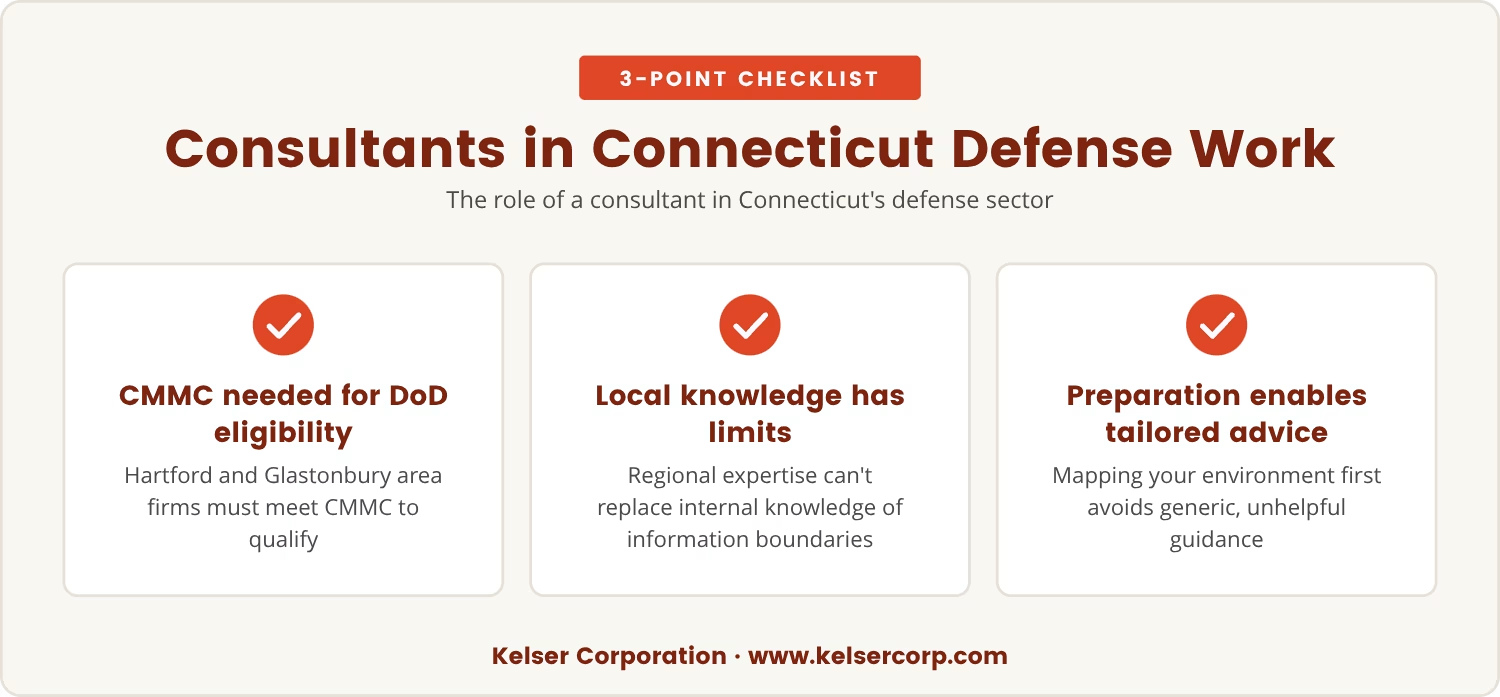
Connecticut businesses working with the defense industrial base face their own version of this challenge. Many organizations in Hartford, Glastonbury, and surrounding areas must meet CMMC requirements just to stay eligible for Department of Defense contracts.
A qualified CMMC consultant understands the regional context and the specific needs of local defense contractors, but even the most experienced consultant can't define your information boundaries from the outside. That knowledge exists only inside your business.
Preparing your environment first means consulting services get tailored to your actual risks and compliance needs, rather than generic advice that misses what matters.
The true value of CMMC consulting services shows up after the initial mapping is done. At that stage, consultants can:
This sequence leads to a smoother path to CMMC accreditation and a stronger cybersecurity posture overall.
Hire a CMMC consultant before mapping your controlled information, and you risk paying for the same work twice. The engagement loses efficiency, and the compliance journey stretches out longer than it needed to.
Investing time upfront to understand your data landscape reverses that pattern and makes every consulting dollar count, keeping your business on track for CMMC certification without unnecessary detours.

Many businesses in Connecticut fall between 25 to 150 users, and it’s easy to feel pressure to bring in help before your information landscape is clear. At Kelser Corporation, we know that the right preparation makes every consulting hour count.
If you want to see how we approach CMMC compliance or discuss your own setup, we invite you to start a conversation with our team.
We’ll match your current IT costs and give you 10% off your first year if you qualify—making your switch to smarter compliance support even easier.
CMMC consulting is about helping your organization prepare for compliance, identify gaps, and build the right documentation and controls. A CMMC assessment is a formal review by a third-party assessor to determine if you meet the required CMMC level. Consulting gets you ready; assessment is the official check.
If your company works with the Department of Defense or handles federal contract information or controlled unclassified information, you are likely required to meet CMMC standards. Review your contracts for CMMC clauses or ask your contracting officer for clarification.
Yes, many consulting services offer ongoing compliance management. This support helps maintain compliance, monitor for new risks, and stay ready for future certification audits, which matters more as requirements continue to evolve.
Look for consultants with experience in cybersecurity maturity model certification, a clear understanding of NIST SP 800-171, and familiarity with your industry. Registered practitioners or organizations accredited by the Cyber AB are a good choice for reliable guidance.
The timeline depends on your organization's readiness, the complexity of your systems, and the CMMC level required. Information already mapped and basic gaps already addressed make the process much faster; without that groundwork, expect delays as the scope gets clarified along the way.