Explore how cloud computing services influence IT staffing and budgets, revealing hidden challenges that can affect your business's flexibility and growth.

November 19, 2026
A help desk that resolves tickets quickly but skips documentation can leave a business unable to switch providers or bring IT support in-house without losing critical knowledge. Fast fixes without shared records create a hidden dependency that can disrupt operations and increase risk.
A fast ticket resolution works like this: a technician identifies the problem, applies a known fix, and closes the ticket, all without writing down what was actually done. That speed looks like success in the moment, but it quietly determines what your business knows about its own systems six months later.
When outsourced IT support services measure themselves purely on how quickly tickets close, documentation becomes the first casualty.
A business that relies on external IT support expects efficiency and expertise, and in the short term it usually gets both. The trouble surfaces only when a fix needs repeating or a provider needs replacing, because without a shared knowledge base, every resolution exists as a one-off event rather than a reusable record. Try to change providers or bring support in-house at that point, and you may find yourself starting from scratch.
Many companies in Connecticut lean on outsourced IT support to handle day-to-day technical issues, manage updates, and keep systems running, and for routine maintenance that arrangement works well. Still, the way a provider documents its work determines whether that efficiency holds up over time or quietly erodes it. The details of that documentation matter far beyond the ticket in front of you.

Fast ticket resolution gets treated as the gold standard for help desk services, since most businesses want employees back to work as quickly as possible. That instinct makes sense, but it creates a tradeoff: when support teams chase speed above all else, they tend to skip documenting the steps that actually solved the problem.
The result is a silent risk rather than an obvious one. With no record of what happened, a business loses the chance to learn from past problems or notice when the same issue keeps resurfacing, which leaves the provider as the sole keeper of knowledge that should belong to the client. Every fix, large or small, then runs through that one gatekeeper.
Left unaddressed, this dependency hardens into something harder to unwind: switching providers or bringing support in-house becomes a far bigger undertaking than it should be. Many businesses only discover how deep that reliance runs when they try to make a change and find the knowledge simply isn't there.
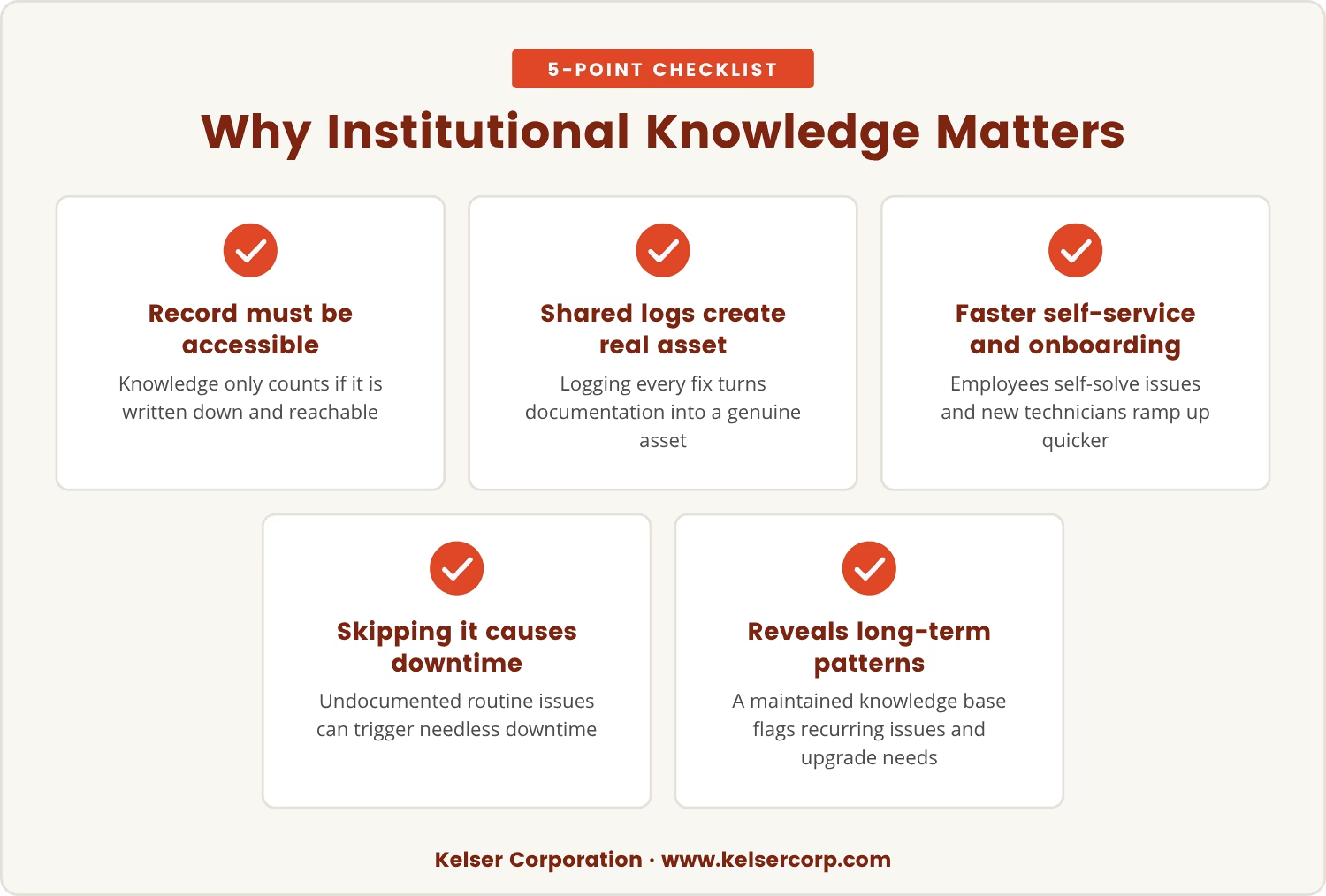
Institutional knowledge is the accumulated record of solutions, processes, and system details that keep operations running smoothly, and it only has value if it is written down somewhere a business can reach. When an outsourced IT support team logs every fix in a shared knowledge base, that record becomes a genuine asset rather than a byproduct of busywork.
That asset pays off in practical ways: employees can resolve simple problems themselves, and new technicians, whether from a different provider or an internal team, can get up to speed without relearning lessons the business already paid for once. Skip the documentation, and even routine issues start causing downtime that didn't need to happen.
Beyond day-to-day fixes, a well-maintained knowledge base reveals patterns over time, flagging recurring technical issues and informing decisions about future upgrades. It stops being about solving today's problem and starts functioning as a foundation for long-term stability.
Switching IT support providers is rarely simple, and it turns considerably harder when a business doesn't own its own support history. If the outgoing provider never documented its work, there may be no record left behind of past issues, applied solutions, or changes made to the system.
That gap shows up immediately in onboarding: a new provider has to troubleshoot from scratch, which drives up both cost and downtime. In the worst cases, a business can lose access to critical details about its own infrastructure, including passwords and software configurations that only existed in one departing technician's head.
For businesses in Connecticut, where regulatory and compliance demands often run strict, this same gap turns into a legal and security exposure, not just an operational headache. Full documentation stops being a nice-to-have and becomes, in many cases, a requirement.

Even reputable providers can drift into prioritizing speed over documentation, and the pattern tends to form the same way each time:
When support teams get measured mainly on response time, writing detailed notes becomes the first task to skip under pressure.
Without a centralized system for logging fixes, solutions stay trapped with whichever technician happened to handle the ticket.
Without regular reviews, gaps in documentation go unnoticed until a problem forces them into the open.
When technicians leave, the undocumented solutions and system details they carried in their heads leave with them.
Without clear processes for sharing information between a business and its provider, important details fall through the cracks.
If a contract never requires documentation, providers have little reason to treat it as a priority.
Cost and response time tend to dominate conversations about outsourced IT support, but knowledge management deserves just as much scrutiny before signing anything. A few questions help surface where a provider actually stands:
For businesses in Connecticut, these gaps carry real stakes, since local companies often operate in regulated industries like healthcare and finance where documentation isn't optional. Skipping accurate records can mean compliance violations, fines, or even data breaches further down the line.
That risk compounds for any business planning to grow, merge, or sell, because a complete support history makes those transitions smoother and shields against unexpected costs when the IT environment shifts underneath a deal.
Ask yourself: if your current provider left tomorrow, would your team have what it needs to keep systems running without interruption? If the honest answer is no, your documentation practices need attention now, not after a transition forces the issue.
A resilient IT environment keeps knowledge shared rather than siloed in one person's head, and building that resilience starts with a few concrete steps:
Taken together, these steps reduce the odds of being left in the dark the moment your IT support situation shifts.

Many businesses in Connecticut with 25 to 150 users depend on outside IT support, but often don’t realize how much they rely on undocumented fixes until a change is needed. At Kelser Corporation, we know how disruptive it can be to lose access to your own IT history.
If you want to see how we approach knowledge management or talk about your current documentation practices, we’re ready to help you take control of your IT support.
We’ll match your current IT costs and give you 10% off your first year if you qualify, so you can take the next step with confidence.
Look for a provider that documents every solution in a shared knowledge base rather than just closing tickets quickly. Confirm upfront whether your business will have direct access to that documentation and how it gets maintained, since transparency here is what keeps a business flexible and secure later.
Write documentation ownership directly into the contract, specifying that all records, passwords, and system notes belong to the business and must be handed over in full if the provider changes. Reviewing access periodically catches gaps before they become a crisis during a transition.
Smaller teams tend to lean more heavily on outside expertise, which makes a thorough record of every fix and update even more valuable. Good documentation lets a business resolve recurring problems faster and limits downtime whenever staff or providers change.
Untracked, undocumented support tickets erase insight into recurring technical issues and the solutions that fixed them before. That blind spot tends to produce repeated disruptions, rising costs, and a gradual loss of control over the IT environment itself.
A well-maintained knowledge base gives a business something concrete to show auditors: proof that required processes are followed and records are kept accurately. That matters most in regulated industries like healthcare and finance, where missing documentation can trigger real penalties.