




Choosing the right IT consulting firm is crucial. Learn how to prevent dependency on outside help and ensure your team can manage new systems effectively.

October 23, 2026
Choosing a consulting firm for its ability to deploy the newest technology can leave a business with systems that only outside experts can maintain. This creates a long-term dependency that many companies never expected.
Picture this: a consulting team spends three months installing a new cloud-based system, hands over the keys, and disappears. Six months later, nobody on staff can fix a login error without calling them back.
That scenario captures a real tension in how businesses choose an IT consulting firm in the first place. The appeal is obvious — modern systems, fresh capability, a shortcut past whatever is slowing operations down today.
Yet the shortcut has a catch. When a consulting group installs tools that only their own specialists can manage, the business ends up with a system nobody inside the company actually understands. It may look more advanced on paper, but daily reality tells a different story.
That gap shows up fastest in the small stuff: your internal team can't support what was built, so every update, fix, or question routes back through an outside vendor. Left unaddressed, that pattern quietly reshapes your company's future.

Modern technology consulting firms build their reputation on introducing advanced solutions — artificial intelligence, cloud computing, custom software, the kind of tools that promise a real productivity jump. That promise, though, comes bundled with a steep learning curve.
Once a system exceeds what your staff can follow, even minor problems turn into real obstacles. Routine issues that used to take ten minutes in-house now require an outside expert on call, which slows response time and wears on team morale.
The pattern turns up often among mid-size companies, particularly across Connecticut. Digital transformation delivers on its promise, but it can just as easily leave a business holding a setup nobody in-house can maintain alone.
Once a project wraps, the IT outsourcing firm typically moves on to its next client, and your business is left holding systems that still need daily attention. If your team never received the training to run those tools, every question sends you back to the phone.
That dependency rarely announces itself all at once — it shows up piece by piece, in a request for help with a routine update, then a troubleshooting call, then a basic configuration change. Individually minor, together these requests turn what looked like a one-time project into an open-ended commitment.
The toll isn't only financial. Confidence erodes inside the team, and flexibility goes with it — when every small change needs outside sign-off, the business loses its ability to adapt on its own schedule.
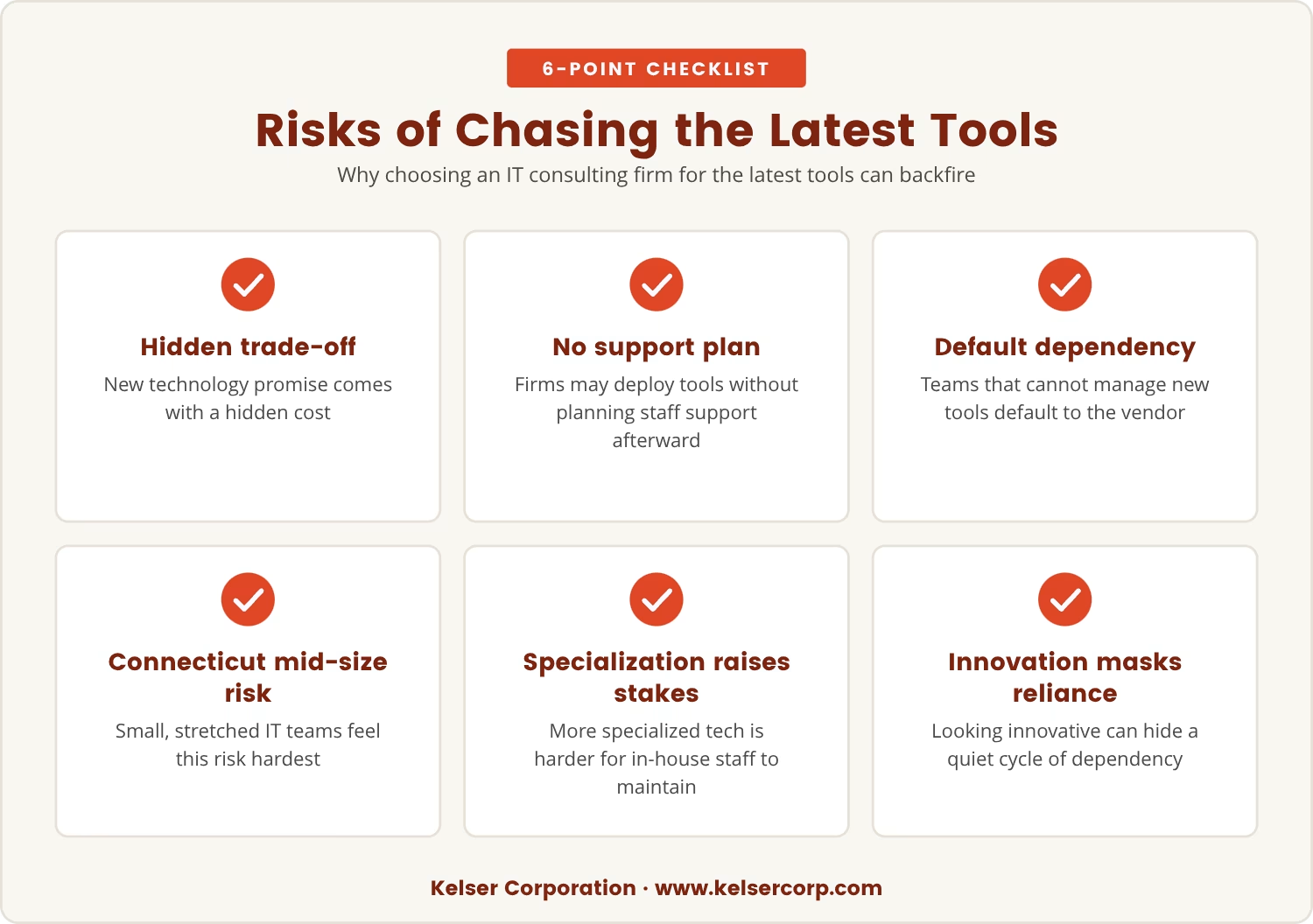
Plenty of businesses choose an IT consulting firm precisely because they want to stay ahead of the curve, drawn in by the promise of newer technology and a competitive edge. That promise carries a hidden trade-off, though.
A consulting company focused on deploying the newest tools doesn't always plan for how staff will support those tools once the project ends. When the team can't manage what's been installed, dependency on that same consulting firm becomes the default.
That risk lands hardest on mid-size companies across Connecticut, where IT teams tend to be small and already stretched. The more specialized the technology, the harder it becomes for in-house staff to keep it running without calling for backup.
What results is a business that looks innovative from the outside while running on a cycle of dependency underneath — freedom traded for a different, quieter kind of reliance.
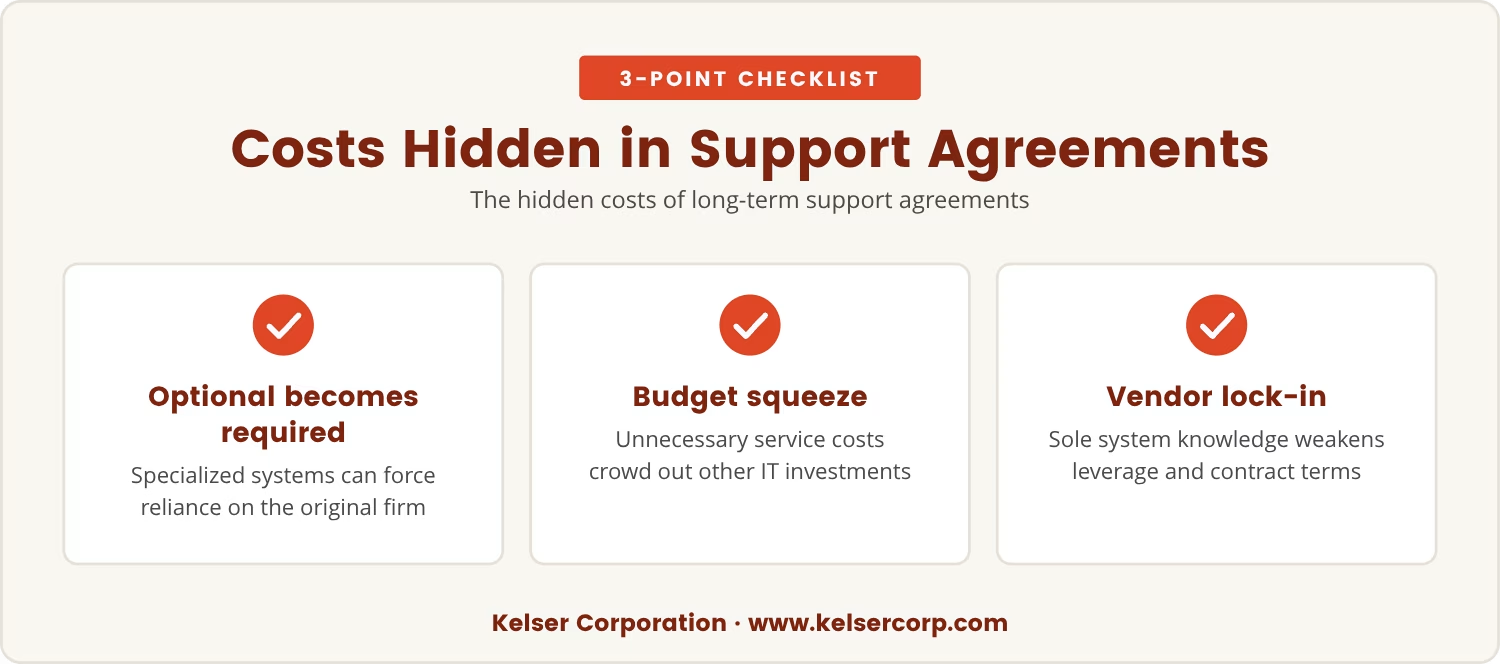
Support agreements read like a safety net, promising quick help whenever something breaks. But once a system grows specialized enough that only the original consulting firm can service it, that agreement stops being optional and becomes a requirement.
The costs compound from there. Money goes toward services that wouldn't be necessary if the internal team could manage the systems directly, squeezing the IT budget and crowding out other investments.
Vendor lock-in follows close behind. When a single consulting group holds all the working knowledge of how systems fit together, switching providers gets difficult, bargaining power disappears, and contract terms tend to favor whoever holds that knowledge.
Before signing a long-term support agreement, ask yourself: could your staff handle these systems with the right training, or are you committing to permanent outside help?
When internal staff can't maintain the technology a consulting firm leaves behind, the effects spread through the business in four distinct ways.
Your team must rely on outside consultants for even minor changes, reducing your ability to make quick adjustments.
Problems that could be fixed internally now require scheduling with the consulting firm, leading to longer downtimes.
Frequent support calls and ongoing service fees can strain your IT budget, especially when issues are routine.
When employees can't solve problems themselves, frustration grows, and confidence in the IT environment drops.
None of this means outside expertise should be off the table — it means the planning has to extend past the day the consultants leave.
That starts with involving your internal team at every stage of the project, not just the kickoff meeting. Push for training that goes beyond the basics, covering updates, troubleshooting, and regular maintenance, and favor solutions that match what your team can already do or reasonably learn.
Every proposed technology deserves a second look through the lens of long-term support: will staff manage it themselves, or will outside help be needed for every change? If it's the latter, weigh other options before committing.
Finally, prioritize consulting services built around knowledge transfer rather than deployment alone — the strongest partners want your team capable on its own once the work is done.
For companies in Hartford, Glastonbury, Manchester, East Hartford, West Hartford, and New Britain, the stakes are concrete. Most businesses in this region run with between 25 and 150 users, with many clustered in the 25-to-70 range, which means IT teams are often small and can't afford to be locked into systems they can't support.
Choosing a technology consulting firm has to be about more than acquiring the latest tools — it's about whether the business can stand on its own once the project wraps. Skip that question, and short-term innovation turns into long-term dependency.

Many companies in Connecticut with 25 to 150 users find themselves with IT systems their own teams can't fully support. At Kelser Corporation, we see how this situation can leave businesses feeling stuck and dependent on outside help.
If you want to see how we approach long-term support and knowledge transfer, let's talk about your current setup or any concerns you have about ongoing dependency.
We'll match your current IT costs and give you 10% off your first year if you qualify—so you can see the value of support that fits your business.
If your team needs to call for help with routine updates, basic troubleshooting, or regular maintenance, dependency may already run deeper than it appears. Track how often outside support gets pulled in for everyday tasks — frequent calls usually mean the systems have outgrown what current staff can manage.
Ask how they plan to involve your internal team and what training will be provided. Find out if the solutions they recommend match your team's skill level, and request documentation or resources for ongoing support. Make sure their approach includes knowledge transfer, not just system setup.
Yes. Advanced tools can open new capabilities, but they can just as easily create problems if staff can't maintain or troubleshoot them. The risk is a business that leans on outside experts for everyday operations, which slows things down and drives up costs.
Support agreements typically cover help with troubleshooting, updates, and system changes. However, if your systems are highly specialized, you may find that only the original consulting firm can provide effective support. This can lead to higher costs and less flexibility over time.
Often, yes — provided the consultants deliver thorough training and documentation. Look for partners who prioritize teaching staff directly and who choose solutions that fit the team's actual learning curve. Given that support, a team can grow more self-sufficient and cut long-term dependency substantially.